I decided to split my first full day in Tokyo into two parts: old Japan and new Japan. Initially, the plan was to head south on the Yamanote line to Harajuku, leave the station and walk west towards Meiji Jingu (Meiji Shrine), do a circuit of the park and then cross over the train tracks to the commercial fashion district to see the kids in their crazy gothic lolita, visual kei, and cosplay styles. As it happened, the battery on my camera conveniently died in the middle of my walk through Meiji Jingu, giving me a pressing reason / convenient excuse for a shopping mission to Akihabara (Electric Town). More on that next post.
Meiji Jingu is beautiful – a peaceful oasis of tall trees, lush green undergrowth, wide gravel walkways, picturesque stone bridges and massive torii (wooden gates) in the middle of bustling Tokyo. As soon as you pass through the wooden beams of the entrance, the city seems to fade away.
Originally built in the 1920s, the shrine was destroyed in World War II and rebuilt in 1958. The forest is incredibly diverse, containing over 350 different species of trees, donated by loyal Japanese from all over the country when the shrine was established. I can only imagine citizens of Hokkaido trying to transport native specimens down to Tokyo in the early 1920s. It must have been an amazing spectacle, and a huge effort.
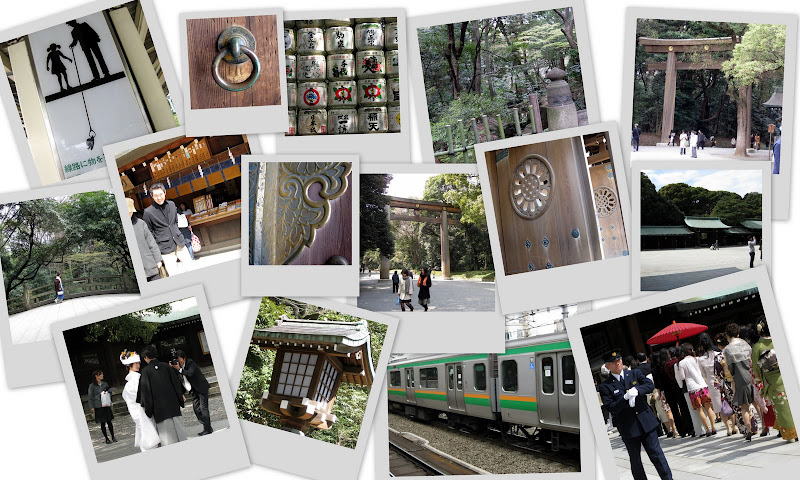
My walk took me all around the inner precinct or “Naien”, past colourful commemorative sake barrels and a Treasure Museum housing items that belonged to Emperor Meiji and Empress ShÅken. At the shrine, there was a wedding procession moving through the courtyard, and a bride and groom outside having their photos taken in traditional Japanese wedding dress. A few international tourists were milling about, as well as some local tourists stopping by to pray.
The ritual for Shinto prayer is to pick up a ladle from the stone fountain, dip and wash your left hand first, then your right, put the ladle under the running tap and pour water into your hand to wash your mouth, then proceed to the altar. You throw a coin into the grated money receptacle, bow twice (full bend at the waist; your back should be parallel to the ground), clap twice with hands near your stomach, then make your supplication to the enshrined God or Goddess, and bow again before leaving.
Useful tip: the 5 yen coin is said to be the best or most effective coin to throw in the prayer bucket (“offertory box” / sei-sen bako). Stephen tells me it’s sort of a pun or homonym; a play on words. “Go-en” means 5 yen, but “en-musubi” means a binding connection, with “en” being “connection”. “Go” is a prefix you can put on things that means “sacred”. So you’re asking for a “sacred connection”. Neat!
After my walk through the dappled spring sunshine and cool leafy breezes, it was a strange transition from all that peaceful emptiness and quiet greenery to the hectic crowds in Shinjuku station at rush hour…