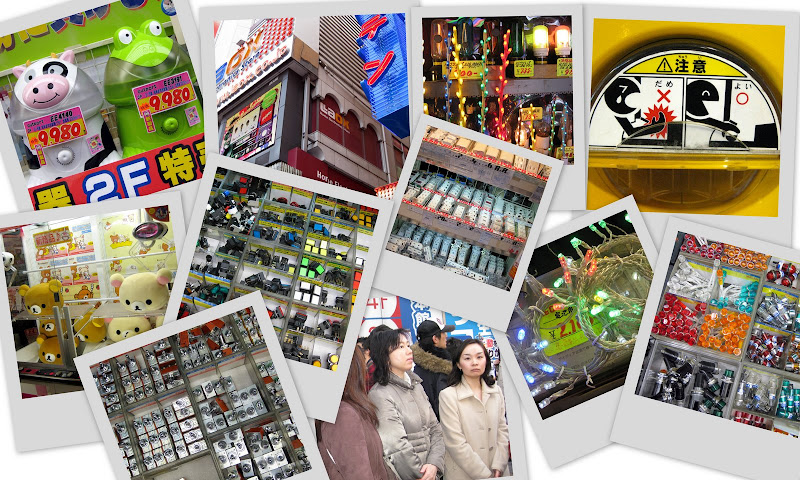
First, my listing of recent vending machine drinks. Managed 7 between yesterday and today; a disappointing yield but I was with friends and we had tea and sake and ginger chai at a cafe – give me a break, my bladder can only hold so much!
1. W coffee Cappuccino Cinnamon: Braced for the hot beverages, I was still surprised by the heat of the dark green can – it burns! Delicious, delicate cinnamon flavouring, though, even though I spilled it all over my bag when I pulled back the tab to open it. First of several spills that day. Recommended.
2. Itoen Roasted Green Tea: One of many short plastic bottles of tea, with an orange label, white lettering and what look like brown twigs – no English words on the label at all. Has a smoky sort of burnt flavour, not at all sweet. Maybe for a more advanced palate than mine; I didn’t like it. Not recommended.
3. Mitsuya Cider: Don’t be fooled – tastes nothing at all like apples. More like 7Up. Fizzy, sugary, nondescript lemon-lime; fine if that’s what you’re into. Not recommended.
4. Qoo (20% something?): Despite the adorable kitten and bunny on the label, this cold orange drink was tasty but really annoying, as the screw-top lid did not seal properly, causing it to leak sticky orange drink all over my jacket pocket, gloves and the inside of my bag. Design fail! Not recommended.
5. Fanta “Furu-Furu” Shaker (aka Fanta Shake-Shake Shaker): A tasty carbonated lemon drink with jelly in it. tStephen says, “highly recommended”. I say, “recommended only if you’re okay with sucking jelly from a can. Recommended.
6. Suntory Cocoa: Tastes kind of like chocolate pudding cups but more liquid. Stephen felt it tasted okay, but the portion size was too small. Recommended.
7. Kochadan Royal Milk Tea: Milky, very sweet, made from 100% Uba tea leaves, mediocre. Tastes like tea for small children. Not recommended.
As my “local” guides, having lived in Japan for nearly 5 years now, Stephen and Skye have been helping me answer 3 pressing questions I had about Japanese cuisine:
– What in the Japanese diet generally (with the exception of sumo wrestlers) makes this country’s citizens so slender and long-lived?
– What is really rude, totally to-be-avoided behaviour at the table when eating in Japan?
– What is the nastiest food Japanese cuisine has to offer?
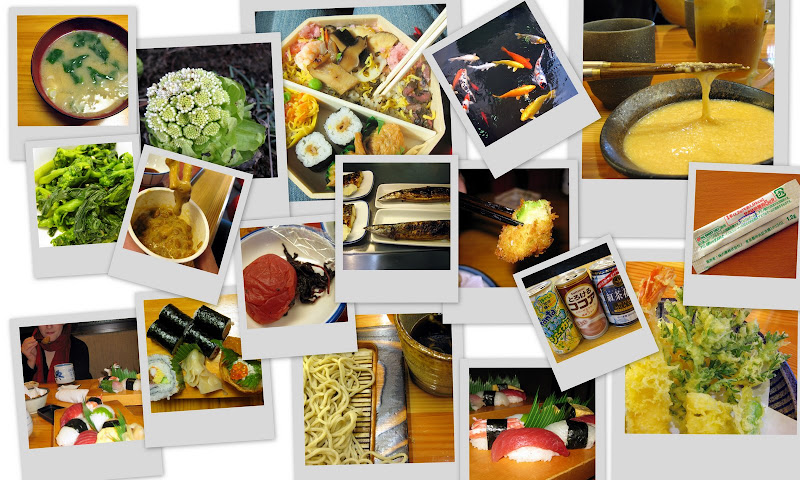
The first question: What do the Japanese eat that keeps them thin and healthy?
I think this is impossible to answer. Foreigners might think the Japanese diet mostly consists of heart-healthy fish and rice, and to some degree this is true. However, take a look at my last entry on vending machine and street food, and you begin to see this is not the whole story. There is a whole lot of fried food happening in Japanese restaurants. I submit to the jury as evidence…
Breakfast yesterday was the Shinjuku-station bento box (cost: 650 yen), full of rice with shredded fishy bits, mushroom slices, lotus root, pickled salt plums, and a variety of other tasty goodies. Skye informs me that each of the larger train stations in Japan have their own bento box called “eki-ben”, so this was a local specialty of sorts. I give it two thumbs up, if you’re ever hungry and in Shinjuku and about to depart on a long train journey: it really hit the spot. I was cruelly tempted by the bevy of tasty pretzel-chocolate stick snacks into buying some Pocky for dessert. Verdict: vegetables, protein, carbs, nothing deep-fried, chocolate pretzels = mostly, but not entirely healthy.
Lunch was with Stephen & Skye at Yamaneko-tei, “Mountain Cat” soba restaurant in Shimo-suwa. We ate delicious buckwheat soba, a local Nagano specialty. There are 2 main kinds of soba noodles in this region: “hachi-ni” (or “8/2”) which are 80% buckwheat, 20% flour, and for the connoisseur, “ju-wari” (or “10×10%”) which are 100% buckwheat and rather dry and lacking in bounce. We ate the less-healthy hachi-ni, accompanied by large dishes of tempura, where otherwise healthy lotus root, eggplant, onion, pumpkin and chrysanthemum leaves were coated in batter and deep-fried until crisp. And of course, we had beer, as you do. Verdict: partly healthy buckwheat, but mostly beer and fried stuff = rather unhealthy.
Dinner was in Matsumoto, at Sushi Ten (loosely translated: “Encyclopaedia of Sushi”). Our meal was prepared by a rare creature: Mama Fujisawa, a female sushi chef, which I’ve been told is a near-mythical creature in Japan. Her family runs the restaurant and they’re really friendly, so much so that I got a goodbye hug even though I was so tired after a day of train rides and castle viewing that I fell asleep under their kotatsu (low, heated table), despite Stephen yelling “gambatte!” at me (which apparently means “suck it up!” in Japanese). The restaurant is just west of the train station and the food was a steal – I recommend going there. I was pretty zombified by jet lag, but I recall there being lots and lots of sushi, and at least 3 deep fried starters, including deep fried chicken parts, deep fried squid and yes – deep fried avocado. Skye placated my feelings of waist-expansion guilt by telling me “it’s a good fat”. Verdict: many deep fried dishes, lots of fatty raw fish, and milk pudding for dessert = not wildly healthy.
The second question, about food taboos and bad table manners, is more easily dealt with.
I was assured there are only two things you should never do at the table in Japan: don’t pass food from your chopsticks to someone else’s chopsticks, pass from chopstick to plate or chopstick to mouth; and don’t stick your chopsticks into your rice and leave them standing upright. Both of these taboos are related to Japanese death rituals. Chopstick passing is for funerals, where family use chopsticks to pass bones from the cremated remains into the urn or other vessel that will act as the receptacle for the dead. And at Obon (Japanese Hallowe’en), the day when the spirits of your dead family return to wander among the living, chopsticks are stuck upright in rice to ritually represent leaving food for the spirits of your ancestors.
The final question: What is the nastiest food Japanese cuisine has to offer?
I know there are some weird fish dishes out there, and Stephen and Skye have repeatedly tried to get me to eat raw horse, but of the things I’ve been willing and able to maneuver into my mouth, here are the two contenders. I think nattou wins the prize, but tororo deserved an honourable mention.
Winner! Slimy, with a consistency somewhere between snot and glue, and a flavour not unlike stale beer mixed with turd, nattou is fermented soy beans that are marketed in Japan as a healthy snack. I don’t wish to malign another culture’s tastes, but personally, I see nattou as something I might find in a remote area of my fridge after a long period of cleaning neglect, and would put on rubber gloves to remove. Stephen was forced to eat it as part of his hazing ritual when he joined the local volunteer firefighters, but has now developed a taste for it. When you eat it, it is necessary to kind of swizzle the chopsticks around below your chin to catch the floating, gossamer-width sticky strings that connect the beans in your mouth to the beans in the dish.
Second place. Slimy, with a consistency akin to snot, but with a compelling BBQ flavour, tororo is made of grated mountain potato, which my friend Skye described as being a vegetable that looks like “a pair of hairy legs”. Look for it in a supermarket near you! See movie below for visual proof of nasty viscosity.