Matsumoto

On day 2 in Nagano Prefecture, Stephen & Skye took me on a day trip to their first home in Japan, lovely Matsumoto. To create a parallel for my GTA readers, Matsumoto could be the Niagara Falls of Nagano. It houses a beautiful black and white castle that is more than 400 years old, surrounded by a large moat full of koi with a distinctive red bridge over it.

There are also some lovely gift shops, including “Wabi-Sabi” where I bought some tabi socks and Stephen & Skye bought me a pair of threaded, easy-to-disassemble travel chopsticks in a lovely silk pouch. And some lovely tea shops, including Salon-as-Salon, on the second floor over a hairdressing salon on the main strip (just down the way from Wabi-Sabi). And the delightful Sushi Ten, which I wrote about earlier as being the place I first tried fried avocado. Now, for some history about the castle…
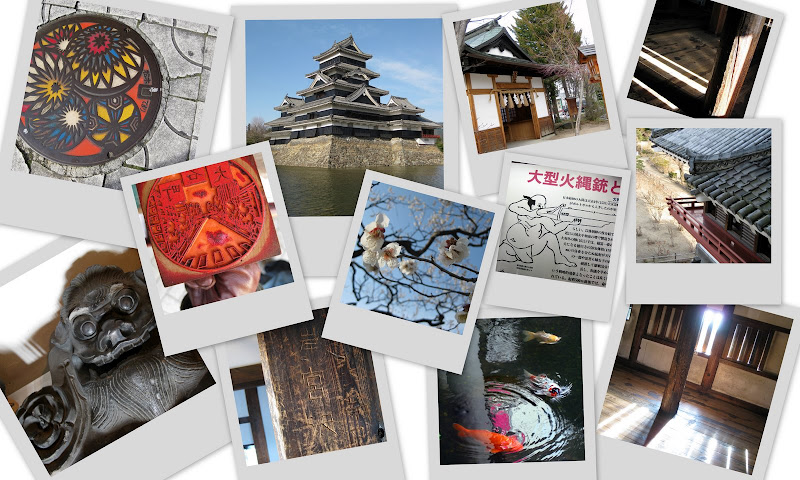
Inui Kotenshu: This minor keep is called Inui Kotenshu, because it stands inui or north-west of the Main Tower. Although it appears to have three stories, it actually has four. One floor is hidden from outside view. Inui-Kotenshu is connected to the Main Tower via a roofed passage. The keep is structurally different from the Main Tower through the use of numerous round pillars: ten pass through the first and second floors, and twelve pass through the third and fourth floors. These pillars were rough-hewn by adzes – an axe-like tool – and made from several types of wood including hemlock, spruce, fir or Japanese cypress.

Yazama & Teppozama: Each floor is fitted with holes for firing weapons. The long rectangular holes, called “Yazama,” were for shooting arrows at the attacking enemy. The square ones, called “Teppozama,” were for firing muskets. Prior to the introduction of firearms from Europe, only Yazama were used in castle construction. After the introduction of firearms Yazama and Teppozama were used in combination. At Matsumoto, there are 60 Yazamas and 55 Teppozamas.

The Sixth Floor: The sixth floor lies 22.1 meters above the ground and could be covered with 16 pieces of rush-woven “tatami”. It was designed to be used as the headquarters of the War Lord (daimyo) if the castle was under attack. Lowered from the ceiling, the Goddess of Nijuroku-yashin (26th night Goddess of the month) is enshrined. There is a legend connected to the Goddess. On the night of January 26, 228, in a vision, one of the young vassals on duty saw a woman dressed in beautiful clothes. Handing him a brocade bag, she said, “if the Lord of the castle enshrines me with 600kg of rice on the 26th night of every month, I will protect the castle from fire and enemy.” It is believed that because the bag was deified the castle was preserved and has survived to be the oldest castle in its original form.

Moon-Viewing Wing: The Moon-Viewing Room has openings to the east, north and south. It is connected to the Main Tower on its western side. With a beautiful exterior vermillion balcony and a vaulted ceiling, an air of refinement is presented here. The openness and refinement reflect the period in which the wing was built – an era of peace following the turbulent age of the warring states. This room was built under the direction of Lord Naomasa Matsudaira, a grandson of Tokugawa Ieyasu – the first Shogun of the Tokugawa period. Currently only two castles, Okayama and Matsumoto, have a moon-viewing wing.
Stephen, Skye & Shimo-suwa

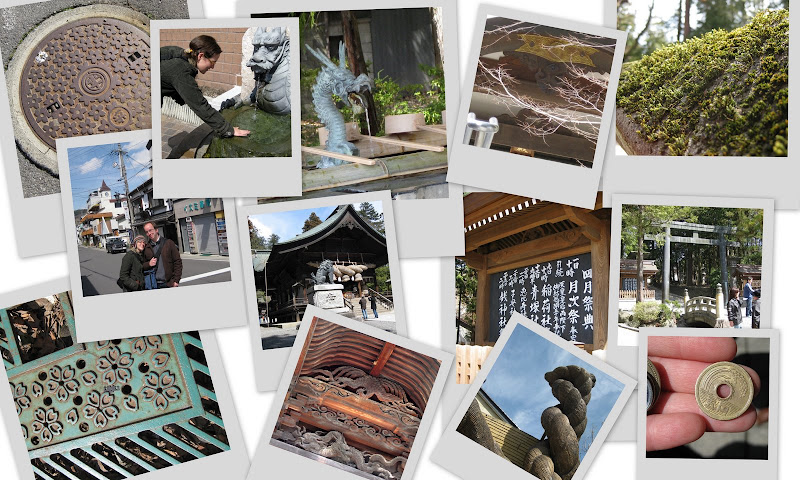
After taking the train for 2.5 hours from Shinjuku, on the Chuo line, I arrived in Shimo-suwa, to be greeted by Stephen & Skye at the station. Across from the station is a tall dead tree and big arc of rope behind a carved piece of stone. This is abstract art symbolizing the Onbashira Festival, held in Shimo-suwa every 6 years, where they cut down 16 giant trees and drag them down from the mountains to mark the 4 corners of the 4 local shrines (spring, autumn, main and front).

After dropping off my bags, getting out my futon and pausing for a cup of tea, we walked along the main street to the public square, where there is another set of huge, dead vertical logs and another massive coil of rope, again celebrating the Onbashira (lumberjack) Festival. We crossed the street looking for a soba lunch, but the restaurant was full so we walked on up the street to the Akimiya (Autumn) shrine.

On the way there was a terrifying pink clown standing in front of what looked like a pink popcorn machine on wheels, guarding the door to a large building: this was a scary, random thing to see in rural Japan. Apparently Shimo-suwa used to be renowned as a manufacturing site for complex, animated music-boxes. It was known as the “Switzerland of the East”, and the building behind the clown was the music-box museum. As further proof that this wasn’t just Stephen pulling my leg, there was also a clock with a model of men rowing a boat right in front of the shrine entrance, that animated when the clock chimed the hour.

There were carvings on the base of the tall stone torii gates to the shrine, which Skye said was the “thank-you” donor name listing, to honour citizens of Shimo-suwa who gave money towards the building and maintenance of the shrine. Just inside the gates on the left was a huge bucket of fancy garbage, including arrows and rakes. Stephen explained that locals buy amulets and charms at the shrine to ward away evil and bring in good luck, but the charms only work for a limited period of time before you have to get new ones. The old charms are returned to the shrine for disposal, and of course you pay for both buying & burning. The rakes were to pull luck towards your house, and arrows to shoot spiritual pollution away from your house.

In front of the shrine on large pillars sit two Koma-inu or “lion-dogs”, one with mouth open (to scare off demons), one with mouth closed (to shelter and keep in the good spirits). They represent Ah and Un (“Ah” is the first letter in the Japanese alphabet and “Un” is the last, just as in Sanskrit) or alpha and omega, birth and death, the beginning and end of the universe.

At the back of the shrine in the area with the collection box, there is no image of the God or Goddess, just a simple round mirror, to reflect the face of the supplicant. To the right of the shrine is a building where visitors can purchase various charms to ward off evil, bring luck, fertility, safe travel, good grades on exams, etc. Stephen & Skye bought me a lovely orange “safe travels” amulet here.

On the way back from the shrine, we paused to look at a well-maintained traditional Japanese garden inside a fancy restuarant on the main strip. This restaurant is owned by a local fertility doctor who is a renowned specialist in Japan; I am informed that there are an unusual number of twins in the area.